
Kasmo, a Texas-based IT firm, didn’t even bother with the acronym, writing on Glassdoor that “NO US Citizen” was eligible for a job training program.
The job post for LanceSoft, an IT staffing firm committed to “diversity, equality, and inclusivity,” began innocently enough.
The $60-per-hour role would be based in Santa Clara, Calif., focus on “technical support,” and entail a 3–10 p.m. shift. Posted on Nvoids, an IT jobs aggregator, the ad described LanceSoft as an equal opportunity employer and said that the firm, one of the largest staffing agencies in the country, strives “to be as diverse as the clients and employees we partner with.”
“We embrace people of any race, ethnicity, national origin, religion, gender identity, and sexual orientation,” the Nov. 25 post read.
This particular job, however, would not be open to a very large group of people: citizens of the United States.
In a section titled “Visa requirement,” LanceSoft recruiter Riyaz Ansari wrote that “candidates must hold an active H1B visa”—and stated explicitly that American citizens need not apply.
“No USC/GC for this role,” Ansari wrote, using the acronyms for U.S. citizens and green card holders. He added that “LanceSoft is a certified Minority Business Enterprise”—a status the firm has used to secure public contracts—and touted the company’s “diversified team environment.”
Federal law bars employers from discriminating based on citizenship status. But in the industries most reliant on the H-1B program, which provides visas to more than 700,000 immigrants, advertisements like LanceSoft’s litter online recruiting boards.
The Washington Free Beacon identified over two dozen job postings since 2024 that appear to bar applications from U.S. citizens. The posts were made on a variety of platforms, including Glassdoor and LinkedIn, and typically indicate a preference for H-1B visas, though some allow for other visa types as well. Several of the firms are minority-owned businesses, meaning they receive preferential access to government contracts even as they exclude U.S. workers.
The posts illustrate what Trump administration officials say is a common form of hiring discrimination that has long been underpoliced. They come as conservatives are debating the merits of the H-1B visa program, which some argue has been abused by employers to hire foreign workers—especially Indian outsourcers—at the expense of American ones.
“A shocking number of covered entities, especially recruiters, continue to express explicit preferences for visa guest workers,” said Andrea Lucas, the chair of the Equal Employment Opportunity Commission (EEOC). “In the shadows of under-enforcement, this type of discrimination has festered.”
LanceSoft removed its post from Nvoids within 24 hours of being contacted by the Free Beacon. Ansari, the LanceSoft recruiter, did not respond to a request for comment.
In theory, the H-1B program lets employers hire high-skilled immigrants when they cannot find qualified U.S. workers. Congress created the program in 1990 to offset predicted labor shortages in tech and medicine—the assumption being that there would not be enough Americans to fill those roles.
But more than three decades later, businesses are hiring H-1B candidates without ever searching for U.S. workers. Critics say the program has become a spigot for cheap foreign labor that allows companies to pay below-market wages while minimizing turnover, since the employer-sponsored visa ties migrants to their jobs. That creates an incentive to hire H-1Bs even when there is no shortage of domestic labor.
Now, some companies are responding to that incentive by restricting certain roles to foreign nationals. And though the Justice Department has fined dozens of employers for discriminating against U.S. citizens—including under the Biden administration—many firms are still posting ads that explicitly exclude Americans.
One recruiter posted on LinkedIn that an IT job in Chicago was open to almost “any visa” but “no USC,” meaning U.S. citizens.
The software company Realign posted on Glassdoor that it would not accept “USC” for a six-figure role.
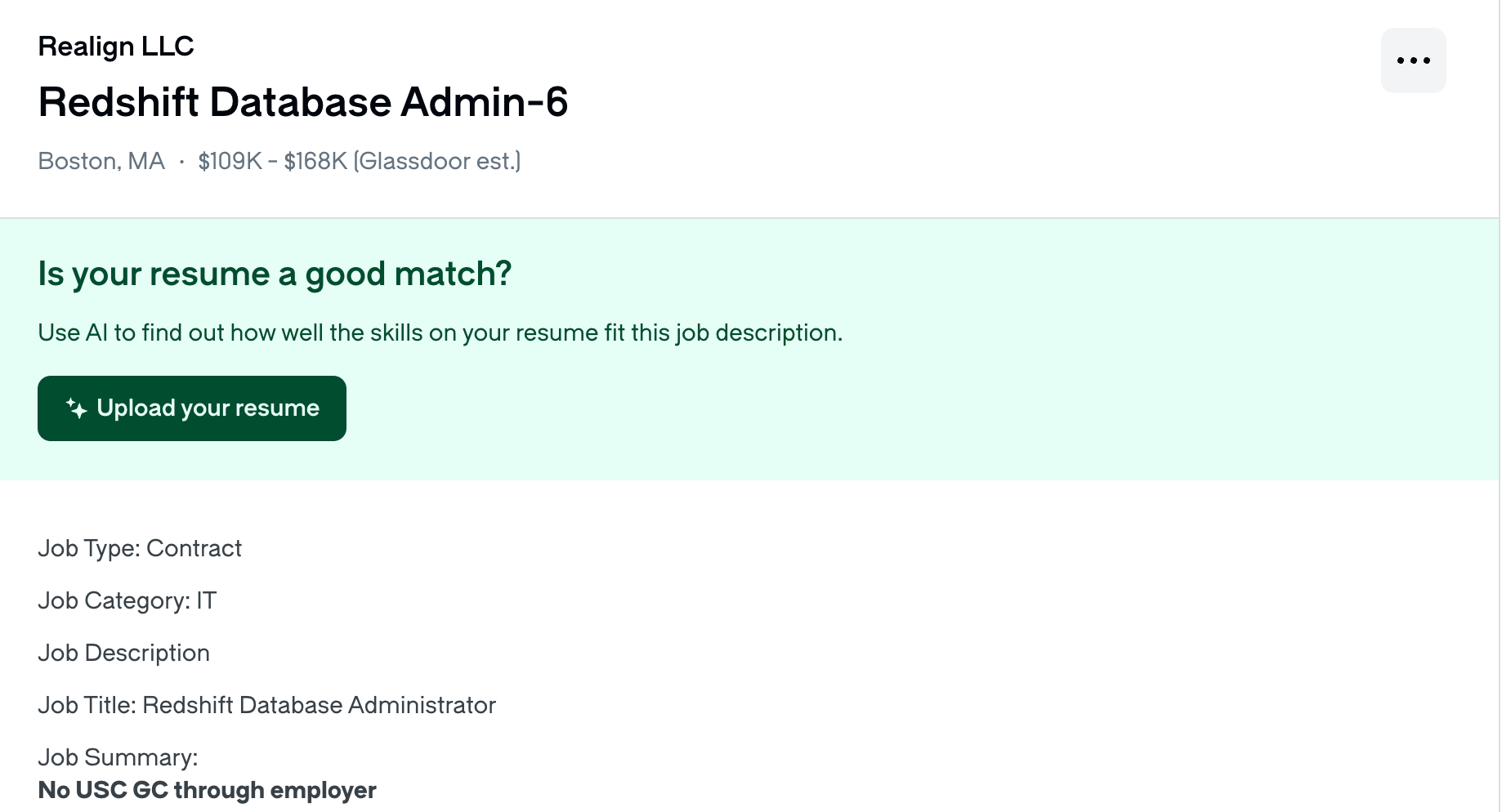
Kasmo, a Texas-based IT firm, didn’t even bother with the acronym, writing on Glassdoor that “NO US Citizen” was eligible for a job training program.
“Need … H1,GC,” the posting said. Kasmo—whose top ranks appear to be composed entirely of Indian nationals—states on its website that “diversity is our strength.” The firm did not respond to a request for comment.
Though Lucas could not comment on specific posts, the ads appear to violate the legal guidance of the EEOC, which warned last month that “discriminatory job ads” violate Title VII of the Civil Rights Act.
“Evidence of discriminatory job ads,” the agency wrote in a fact sheet, “can include ads that say the employer prefers or requires applicants from a particular country or with a particular visa status (for example, ‘H-1B preferred’ or ‘H-1B only’).”
Dan Morenoff, the executive director of the American Civil Rights Project, said the ads on LinkedIn and Glassdoor clearly ran afoul of that guidance.
“If you were trying to write a hypothetical, paradigmatic example of the kind of national-origin discrimination the EEOC has warned against, you’d write Kasmo’s posting,” Morenoff told the Free Beacon. “It’s jaw-dropping that it and dozens of other employers have chosen to advertise that they’re doing precisely what their regulator has warned will result in liability.”
Many of these companies are run by Indian nationals, who made up 70 percent of H-1B visa-holders in 2024. Those demographics have allowed some of the firms discriminating against Americans to claim Minority Business Enterprise (MBE) status, a certification that can give them a leg up when bidding for contracts in the United States.
One MBE, Empower Professionals, has posted multiple advertisements since 2024 that appear to explicitly exclude American citizens. Another, Tekgence, posted an ad for a Java developer that said “No USC.”
While it is unclear whether either firm has benefited from its MBE status, many state and local governments set aside a certain percentage of their contracts for minority businesses, as do many public universities. City Colleges of Chicago, for example, awarded a contract to LanceSoft—the company that excluded U.S. workers from the job in Santa Clara—after determining that it complied with the college’s MBE “participation plan,” according to a procurement document from the school. The college is overseen by Chicago’s city council and receives both state and federal funds.
“It shows real brass to so publicly keep using government money to violate government law,” Morenoff said.
Empower Professionals and Tekgence did not respond to requests for comment.
The job posts, which have not been previously reported, are likely to inflame intra-right tensions over the H-1B program. President Donald Trump has argued the program is necessary to bring talent to the United States, a position shared by some of the president’s allies in the tech sector, including Elon Musk. Others, like Missouri senator Eric Schmitt (R.), say it depresses wages and diminishes job opportunities for Americans, citing cases such as a 2015 scandal in which Disney workers were laid off and replaced by H-1B holders.
Some progressives have also cast doubt on the idea that the visa is plugging labor shortages or bringing in the best and brightest: A 2015 analysis by the Economic Policy Institute, a left-leaning think tank with ties to Sen. Elizabeth Warren (D., Mass.), found that the two leading employers of H-1B holders, Infosys and Tata Consultancy Services, use the visa “primarily to cut labor costs.”
While cost-cutting and outsourcing are not unlawful, Lucas, the EEOC chair, said that companies cannot discriminate against U.S. workers even when doing so would save money.
“Many businesses wrongly think that they can justify hiring preferences for H-1B workers or other guest visa workers based on cost savings,” Lucas said. “But in reality, no cost considerations ever justify unlawfully favoring foreign workers over American workers. It is irrelevant whether the disparate treatment based on national origin is motivated by cost versus bias or animus—either way, it is against the law.”
Visa-based discrimination can result in major fines. In 2023, Meta paid $25 million to settle allegations from the Justice Department that it had “used recruiting methods designed to deter U.S. workers from applying to certain positions.” Epik Solutions, a technology recruitment company in California, reached a similar settlement this year after it stated in multiple job ads that certain roles were reserved for H-1B visa holders.
The Justice Department said the ads violated the Immigration and Nationality Act, which, like Title VII, bans discrimination based on citizenship status. Other companies that have been fined for posting similar ads include IBM, Ikon Systems, Technology Hub, and American CyberSystems.
More at:

Parents say school-issued iPads are causing chaos with their kids
A growing contingent of public school parents say school-mandated iPads, particularly in elementary and middle schools, are leading to behavior problems.
LOS ANGELES — Lila Byock’s son had always been good at math. But when he started sixth grade last year, he began to bring home D’s and F’s. It crushed his self-esteem. His teachers told Byock that he clearly understood the material, she said, but he just couldn’t stay on task on his school-issued Apple iPad.
Her son’s school, like many in the Los Angeles Unified School District and across the country, provided an iPad to each student for use throughout the school day, even during band and gym class.
The iPad program, which ramped up during the Covid pandemic, was meant to give kids a technological leg up and help track students who are falling behind. But Byock said her son revealed that he used the iPad during school to watch YouTube and participate in Fortnite video game battles.
“It makes no sense to me,” Byock said. “We’ve banned the cellphones, but it doesn’t matter, because the kids are using the school-issued devices in exactly the same way.”
In February, the district’s ban on use of personal devices, including smartphones and smartwatches, went into effect.
Byock began speaking with other parents of elementary and middle school children, invited a group of them to her house for wine and cookies and heard stories similar to hers from parents who had been trying to raise their kids with as little screen time as possible.
One mother described how her 6-year-old son had repeatedly wet himself in class when he got fixated on activities with his tablet, and another said her teenage son had gotten sucked into communicating with strangers online via popular websites and forums and at one point ran away from home with the school-issued iPad.
Byock created a parent coalition called Schools Beyond Screens, which is organizing in WhatsApp groups, petition drives and actions at school board meetings and demanding meetings with district administrators, pressuring them to pull back on the school-mandated screen time.
The pushback has reached a fever pitch this month after a series of tense meetings with school officials about the topic. Los Angeles Unified is the first district of its size to face an organized — and growing — campaign by parents demanding that schools pull back on mandatory screen time.
The discontent in Los Angeles Unified, the second-largest school district in the country, reflects a growing unease nationally about the amount of time children spend learning through screens in classrooms. While a majority of states prohibit children from using cellphones in class, 88% of schools provide students with personal devices, according to the National Center for Education Statistics, often Chromebook laptops or iPads.
The parents hope getting a district that has over 409,000 students across nearly 800 schools to change how it approaches screen time would send a signal across public school districts to pull back from a yearslong effort to digitize classrooms.
“I basically have reoriented my entire life and gone down this rabbit hole, because it’s so crazy to me what’s happening and that we’re just letting this happen,” Byock said.
District officials say that on average, students spend less than two hours a day on screens, according to the tracking software used by the district’s Chromebooks, though it doesn’t track iPad usage.
Superintendent Alberto Carvalho also cautioned at a recent board meeting “that restricting to some means eliminating,” echoing a doctrine dominant in education that public schools should ensure students of all socioeconomic backgrounds are equipped for a digital-first world.
“Do we have a problem specific to digital tool addiction in America? Yes, we do,” he said at a Sept. 9 meeting. “Schools are not the reason. Not even close. Parental responsibility is very much a part of this equation. Period.”
A district spokesperson said in a statement that teachers “have the flexibility to select from a variety of approved and vetted instructional resources based on the needs of their students,” as long as they follow guidelines. When concerns crop up, the spokesperson added, teachers should work directly with families to “adjust as appropriate according to students’ needs and instructional best practices.”
Students in grade levels as low as kindergarten are provided iPads, and some schools require them to take the tablets home. Some teachers have allowed students to opt out of the iPad-based assignments, but other parents say they’ve been told that they can’t. Parents can also opt their children out of having access to YouTube and several other Google products.
Nick Melvoin, the Los Angeles school board member who wrote the 2024 phone ban resolution, the first of its kind for such a large district, said he has been considering proposing to prohibit students’ using devices until second grade after having heard from concerned parents.
Melvoin said that some schools are misinterpreting district wide policies about learning assessment software and that the district needs a better accounting of how schools are using devices. “The cellphone ban was almost rudimentary — like, let’s just get rid of them,” he said. But with educational software in class, it’s not as simple, “because then if the pendulum swings too far; we’re doing kids a disservice.”
When Los Angeles Unified began providing personal laptops and tablets to students a decade ago, district leaders described it as a “civil rights issue” to get children of all backgrounds on equal technological footing. The billion-dollar 2014 initiative to give tablet computers to everyone became a scandal after the bidding process appeared to heavily favor Apple, and it faced criticism once it became clear that students could bypass security protocols and that few teachers used the tablets.
Currently, the district leaves it up to individual schools to decide whether they want students to take home iPads or Chromebooks every day and how much time they spend on them in class.
…

Parents have reported a myriad of issues associated with using the iPads.
Kate, a mother of two boys in North Hollywood, who spoke on the condition that her last name not be published to protect her child’s medical privacy, believed the mandatory i-Ready time created a health issue for her first-grade son.
This fall, Kate said, her son’s elementary school notified her that he wet his pants during iPad time, which was required for an hour a day to complete i-Ready assignments. He’d never done that before at school or home, she said, but it happened four times over a month. Her son cried after each incident and asked, “what’s wrong with me?” according to emails Kate exchanged with the school.
“I went ballistic, because this shouldn’t be happening,” she said. “I felt like this was becoming a humiliation ritual.”
Kate said she and her son’s pediatrician believed the time on the iPad, when he had to use headphones for on game-based quizzes, were overstimulating and made it difficult for him to notice normal bodily signals. The teacher agreed to limit her son to only 20 minutes a day on an iPad or a Chromebook, and he hasn’t had an accident since, Kate said.
District officials tell schools that students should use i-Ready for only 45 minutes per week in each subject. However, Maria Nichols, president of the Associated Administrators of Los Angeles, the principals’ union, said the district will “pester” her members to show improvement in reports. The result, she said, is that it’s now normal to walk into a classroom and see all the students staring at devices with headphones on and no direct teaching or conversation occurring.
The i-Ready software generates new and unique questions for students based on their histories and user profiles using an algorithm, but parents and teachers are unable to see what children are asked, in part because the company that makes the program considers them proprietary information.
More at:


More Stories
Biden’s immigration failures went far beyond the border
House Dems’ Response to Ilhan Omar Warrant: Eliminate Homeland Security
BREAKING: Federal Agents RAID Far-Left Rep. Ilhan Omar’s Washington, DC Home in Pre-Dawn Operation