Why I changed my mind about Hydrogen Water – Dr. Paul Saladino MD
The Bacon Paradox
We stopped eating cured meat to save our hearts. We ended up destroying the very mechanism that protects them.
In 1998, three scientists won the Nobel Prize for discovering a molecule that saves lives. It relaxes blood vessels. It lowers pressure. It prevents heart attacks. It is called Nitric Oxide. The primary raw material for this miracle molecule is the very thing we have spent fifty years trying to banish from our breakfast tables. We are running away from the cure because we have confused it with the poison.
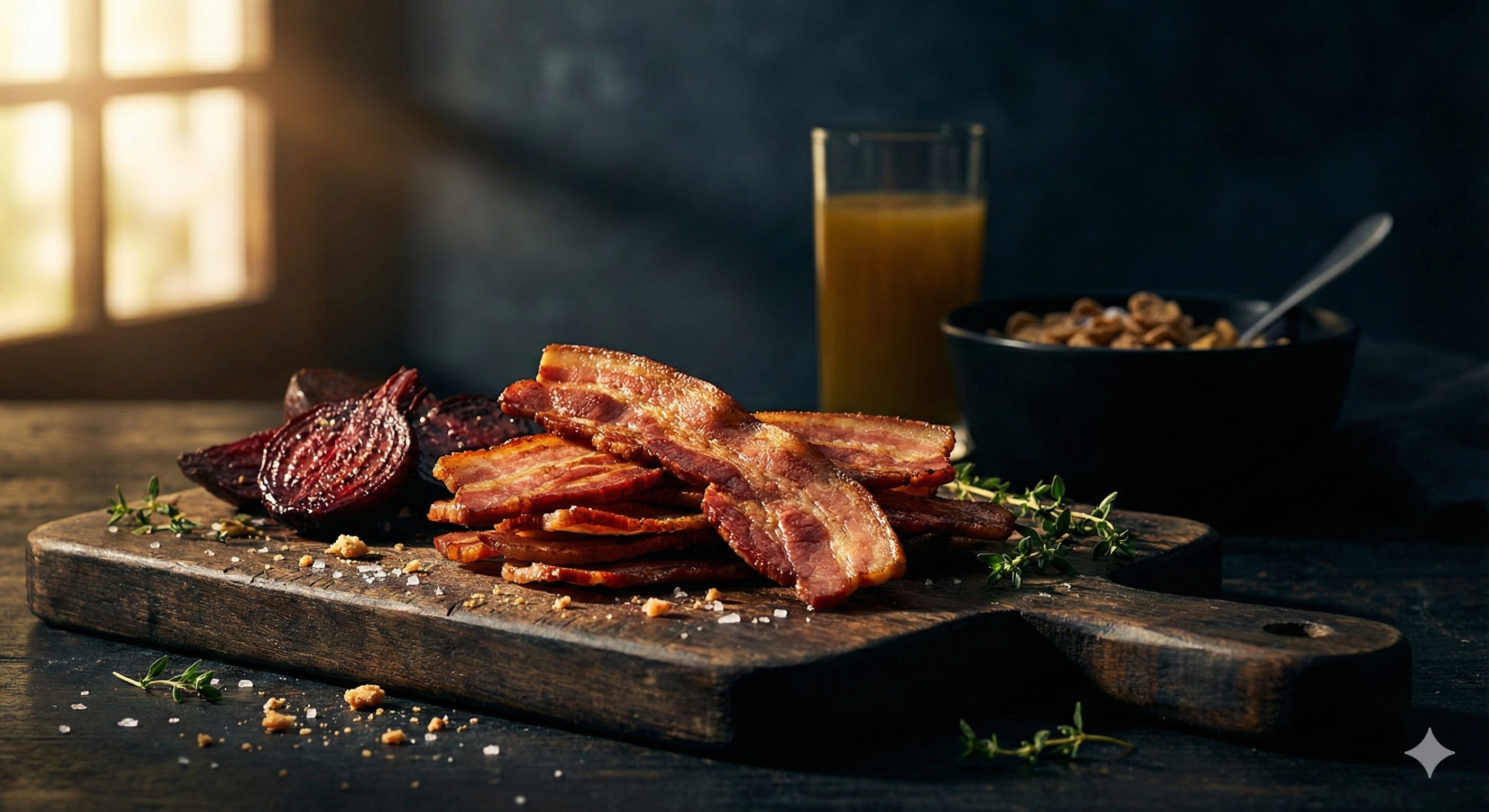
The Green Truth
Here is the inconvenient fact that the “clean eating” lobby forgets to mention. Vegetables love nitrates. They soak them up from the soil like a sponge.
Beetroot. Rocket. Spinach. And yes, celery. These are the nitrate heavyweights. A 100g serving of rocket contains more nitrates than 5 kgs of bacon or hotdogs. If nitrates were truly the toxic assassin we are told they are, a salad would be a suicide note.
Yet, nobody is protesting against spinach (which has twice the level of rocket). We consider these vegetables “superfoods.” We blend them. We drink them. We feed them to our children.
So why is the nitrate in a bacon sarny a killer, but the nitrate in a beetroot a hero?
The molecule is identical. The body cannot tell the difference between a nitrate that came from a pig factory and a nitrate that came from a garden.
The Scam of “Uncured” Meat
This brings us to the great deli counter swindle.
When you buy “Nitrate-Free” bacon, flip the packet over. Look at the ingredients. You will almost certainly see “Celery Powder” or “Cultured Celery Juice.”
This is not a flavouring. It is a loophole.
Manufacturers know that consumers are terrified of the words “Sodium Nitrite.” So they stopped adding it. Instead, they take celery – which is naturally loaded with nitrates – dry it, concentrate it, and dump it into the meat.
It performs the exact same chemical function. It cures the meat. It turns it pink. It kills the botulism bacteria. But because it came from a vegetable, they can legally slap a “No Added Nitrates*” label on the front.
(*Except those naturally occurring in celery powder.)
It is chemical money laundering. They are selling you the exact same molecule, but charging you double for the privilege of lying to you.
The Blood Pressure Paradox
The irony is that you actually want nitrates.
For years, we thought they were inert waste products. We were wrong. In the 1990s, scientists discovered the “Nitrate-Nitrite-Nitric Oxide” pathway.
When you eat a nitrate (from bacon or beets), bacteria in your mouth convert it into nitrite. You swallow the nitrite. Your stomach acid converts it into Nitric Oxide.
Nitric Oxide is a miracle molecule. It relaxes your blood vessels. It lowers your blood pressure. It improves athletic performance. It is the mechanism behind Viagra.
This is why beetroot juice lowers blood pressure. It is the nitrates. If you successfully eliminated nitrates from your diet, you would likely become hypertensive and impotent.
The Sweet Saboteur
Here is the twist of the knife. While we are busy hyperventilating over the nitrates in bacon – which, remember, actually help produce Nitric Oxide -we are blindly consuming the one ingredient that actively destroys it.
Sugar.
Specifically, fructose. When you eat sugar, the liver breaks it down. One of the primary byproducts of this process is Uric Acid.
Most people know Uric Acid as the crystal that causes gout (the “disease of kings”). But it has a far more sinister day job. Uric Acid inhibits Nitric Oxide Synthase, the enzyme responsible for creating that miracle blood-pressure-lowering molecule.
This creates a physiological double-bind.
We avoid the cured meat, depriving ourselves of the raw materials for Nitric Oxide. Simultaneously, we replace the savoury breakfast with a sweet one – processed cereals, orange juice, toast with jam – flooding our system with uric acid that shuts down whatever Nitric Oxide production we had left.
We are terrified of the bacon that lowers our blood pressure, while happily eating the sugar that raises it.
The Real Villain
So where did the fear come from?
It came from a legitimate chemical reaction that happens under very specific circumstances. When nitrites are exposed to high heat in the presence of amino acids (proteins), they can form Nitrosamines.
Nitrosamines are indeed potentially carcinogenic.
But here is the twist. Vegetables contain Vitamin C and antioxidants. These compounds naturally block the formation of nitrosamines. They turn the reaction off.
Meat does not naturally have Vitamin C. This is why standard cured meats usually have Vitamin C (Ascorbic Acid – E300) or Sodium Erythorbate (E316) added to them. It is the safety switch.
The risk doesn’t come from the ham sandwich. It comes from the cooking method. If you burn your bacon until it is black charcoal, you are manufacturing nitrosamines. If you gently cook it, you aren’t.
The Verdict
It is a tragedy of errors in two acts. First, we banned the raw materials for heart health (nitrates) because we didn’t understand the chemistry. Second, we replaced them with the agent of heart disease (fructose) because we liked the taste.
We threw away the fire extinguisher and replaced it with a can of petrol. The danger is not in the cured meat. It is in the glass of orange juice you wash it down with.
More at:

Benefits & Harms of Light – Dr. Glen Jeffery
It’s not just Gen Z — all ages are being hit hard by this damaging side effect of social media
We’ve all heard how social media is devastating teen mental health — but a shocking new report confirms it’s robbing pretty much everyone of the ability to focus.
The meta-study from Griffith University in Australia analyzed 71 surveys with more than 98,000 research subjects and found that consuming short-form video is associated with diminished attention span and inhibition control.
“I used to think the main damage from social media was to youth mental health,” psychologist Jonathan Haidt, author of the bestselling book “The Anxious Generation,” recently posted on X. “Now I believe that the global destruction of the human ability to pay attention may be even larger.”
Talking to The Post, he went even harder: “Humanity is getting stupider, thanks to our technology, at the exact moment when our machines are getting smarter … It started as soon as we all started carrying smartphones and scrolling past anything that contained four seconds of boredom.”
And that goes for all ages. John, a 27-year-old law student from Michigan says short-form video — like TikToks and Instagram Reels and stories — has taken a toll on both him and his Boomer mom.
He admits it’s hard to watch TV without reaching for his phone and that he never eats a meal without engaging with some form of social media.
“In class it can be hard to focus on what the professor is saying for more than a few minutes without checking my phone or opening LinkedIn. It feels like a compulsion,” said John, who asked to withhold his last name to protect his family’s privacy.
“I’ve seen Facebook addiction in my parents, which is having a way more detrimental effect on them than it is on me, because at least I’m cognizant of the tactics [used by social media companies],” he said. “My Boomer parents are not.”
He estimates that his mom, who is retired, spends three to four hours on Facebook a day.
“For me, this is the saddest aspect of social media,” he said. “It has taken my mother’s attention during a time when she is supposed to be reaping the rewards of a long career.”
Griffith University researchers found the negative association between attention and short-form content — defined as videos lasting a few seconds to a few minutes — was consistent across all age groups and all social media platforms.
“Repeated exposure to highly stimulating, fast-paced content may contribute to habituation, in which users become desensitized to slower, more effortful cognitive tasks such as reading, problem solving, or deep learning,” the researchers hypothesized. “This process may [gradually weaken] the brain’s ability to sustain attention on a single task.”
Educators are certainly seeing it.
Students “often can’t sit still or keep thoughts inside their heads,” Murphy Kenefick, a 28-year-old literature teacher at a Nashville high school, told The Post. “From not being able to actually read anything to [not] paying attention in class, it’s a problem.”
Some teachers are beginning to recognize the same symptoms in themselves.
A former high-school history teacher in Jonesboro, Georgia, Jordan Snow read hundreds of books just to obtain his two degrees — but admits he now “struggles to read a book consistently” thanks to social media.
“I’ve found myself unable to watch a movie [without] picking up my phone just to scroll,” Snow, 46, said.
There’s something incredibly insidious about Big Tech stealing any conscious control over our lives. Teens, it turns out, were canaries in the coal mine, warning that something catastrophic was about to happen to all of us.
And people are absolutely feeling it: A 2024 poll by Common Sense Media found that a majority (51%) of young adults aged 18 to 22 believe that social media has reduced their attention span.
Hiba Belghazi, a 24-year-old psychology student in Montreal, said YouTube was “pretty much [her] third parent growing up” and that she developed the habit of doom-scrolling when bored or stressed.
But she resolved to read 52 books this year — and has nearly met her goal. The secret to her success? She deleted social media apps and blocked YouTube on her browser.
“Emotions came up that I had been repressing — a restlessness that I had been numbing with YouTube. It was a desire to do things,” she said. “We vastly underestimate the waste of human potential and the energy being drained by these apps.”
More at: