
President Trump’s heralded decision to make DEI DOA couldn’t come a moment too soon for Nicole Parker.
The so-called diversity, equity and inclusion initiative was a boondoggle that wrought incalculable damage across every sphere of employment in the country.
No one knows that better than Parker, a former FBI special agent of 12 years who described how a civil war brewed inside the once-venerable agency, with “lines drawn” between two clashing factions she termed “FBI 1 versus FBI 2.”
One side represents “integrity, meritocracy and protecting the American people” while the other force pushes “personal agendas and identity politics, DEI and politically motivated cases” in lieu of serious crime investigations and “the upholding of law and order replaced by performative posturing.”
By the time she left Wall Street to join the FBI in 2010 at age 32, Parker writes in her new book, “The Two FBIs: The Bravery and Betrayal I Saw In My Time At the Bureau,” that she saw segments of the bureau “becoming increasingly obsessed with diversity,” with breathless announcements about new clubs, meetings and “other diversity events.”
A mere three years later, Parker described the newly formed “Office of Diversity and Inclusion” and “Diversity Advisory Committee” and by 2015, “diversity” was added as a core value of the bureau — which she claimed had nothing to do with “protecting the US from terrorist attacks” and combating threats that should have been priorities at the heart of the agency.
The declaration, “We know that a more diverse workforce allows us to connect with and maintain the trust of the American people” even appeared on the agency’s public website.
While standards “deteriorated” during the era of President Barack Obama and bureau Director James Comey, Parker claimed, under President Joe Biden and Director Christopher Wray “it really amped it up” and “morale took a serious hit.”
“Under the Biden administration, they were hiring idiots,” Parker bluntly claimed to The Post. “Hiring standards dropped and it was noticeable, lowering the standards to meet quotas.”
It was all part of an insidious apparatus that degraded the agency to which she devoted more than a decade of her life.
In addition to being the agent in charge of the Parkland school shooting for the bureau, doing the death notifications, Parker worked high-profile investigations, specializing in human trafficking, violent crimes, active shooting situations and manhunts — until, after much soul-searching, she ultimately walked away in October 2022.
Days before the Parkland, Florida, high school massacre that saw 17 students and staff killed at Marjory Stoneman Douglas High School, Parker described a diversity event at the bureau — and how Wray’s priority seemed to be on that, rather than taking tips.
“I had to tell shattered parents that their child was dead when it could have been stopped,” she told The Post.
“My blood was boiling. What if instead of focusing so much time and energy on diversity, such as the Diversity Agent Recruitment (DAR) event that Director Wray had attended nine days before, only twenty-seven miles south of the Parkland killing spree location, he had prioritized hiring the best and brightest and making sure that they were properly trained to know how to document a tip that might have saved seventeen lives?
“In my mind, the improper prioritization of diversity might have cost those lives,” she writes.
For Parker — a Texas native and former hedge fund exec who was traumatized by witnessing 9/11 from the World Financial Center (Brookfield Place) — it was a tale of two FBIs, essentially one good, one sinister.
She described “FBI 1” as “honorable patriots working hard protecting Americans, upholding the Constitution in a fair and unbiased manner, working legit investigations and fighting real crime.”
The insidious FBI 2, in sharp contrast, is the “antithesis” of their brethren. They are described as FBI members who “abuse their law enforcement power to push their political and social agendas,” and those who are “self-promoters in leadership positions” either at headquarters in DC or executive management nationwide.
FBI 2’s “shameful actions have destroyed the bureau’s once stellar reputation,” she says.
The DEI scourge is responsible for more FBI failures than people realize, she said.
“There are many people who are highly incompetent, who aren’t where they should be based on merit, and that’s dangerous,” Parker, who was based in the Miami Field Office, contended. “And when your focus is not on the proper priorities, the safety of Americans, people get hurt.”
Her best friend, Laura Schwartzenberger, a 43-year-old married mom of two, was a former special agent SWAT operator who was killed when she was shot in the head alongside a fellow agent while executing a search warrant on a child predator in Florida on February 2, 2021.
“There was no SWAT support for her. They were not deliberately sending SWAT resources for child predators like they were for January 6th misdemeanors,” alleged Parker, referring to prosecutions over the 2021 storming of the US Capitol and adding that the problems were bubbling for years. “Between DEI, social justice warriors, political weaponization and lazy employees, the FBI’s issues did not start overnight.”
With the January 6 “obsession” and the FBI’s 2022 Mar-a-Lago raid “scam” to seize classified documents, Parker said she’s far from the only “FBI 1” agent who’s walked away.
“As soon as I left, people started reaching out to me, saying, ‘Enough is enough,’” she claimed.
“People think that the bureau just went after conservative Americans outside [the agency],” Parker said, adding that with cues like the COVID-19 vaccine that often fell along political lines, FBI 2 “would go after you internally. They were picking on employees too.”
“They would go after people that stood up to them internally. It was like career suicide for many people that stood up to the Biden administration,” she claimed.
Watching the recent Brown University attack in which two students were killed by a masked gunman, Parker claimed, “DEI causes death — and that’s what you saw at Brown,” adding that the tragedy could have been prevented “if they focused on proper cameras and security and not being woke.” Parker quoted a campus security guard as saying, “I’m focused on this ‘Free Palestine’ thing.”
The shooter in that case, Claudio Neves Valente, was found dead by authorities a few days later.
She added that Brown “was more concerned about woke movements and making ‘safe spaces’ on their campus so everyone could feel loved and included. And freeing Palestine rather than addressing their on-campus threat risk and safety vulnerabilities such as no cameras on an entire section of the school.”

Still, Parker, who’s now a Fox News Media contributor, is confident the bureau can earn back the public’s trust and turn itself around — with time.
Under Trump, she predicted that “FBI 2” “will be eradicated as its political and social weaponization is dismantled and those responsible for its downfall will be held accountable. The FBI will regain Americans’ and FBI employees’ trust and return to excellence. There will no longer be two FBIs,” she writes, adding that current Director Kash Patel is focused on “keeping America safe.”
“There will be one honorable FBI exemplifying fidelity, bravery, and integrity. That is what our current, retired, and fallen FBI heroes’ legacies deserve. Most of all, that is what Americans deserve,” she added.
More at:

Journal retracts weed killer study backed by Monsanto, citing ‘serious ethical concerns’
The journal Regulatory Toxicology and Pharmacology has formally retracted a sweeping scientific paper published in 2000 that became a key defense for Monsanto’s claim that Roundup herbicide and its active ingredient glyphosate don’t cause cancer.
Martin van den Berg, the journal’s editor in chief, said in a note accompanying the retraction that he had taken the step because of “serious ethical concerns regarding the independence and accountability of the authors of this article and the academic integrity of the carcinogenicity studies presented”.
The paper, titled Safety Evaluation and Risk Assessment of the Herbicide Roundup and Its Active Ingredient, Glyphosate, for Humans, concluded that Monsanto’s glyphosate-based weed killers posed no health risks to humans – no cancer risks, no reproductive risks, no adverse effects on development of endocrine systems in people or animals.
Regulators around the world have cited the paper as evidence of the safety of glyphosate herbicides, including the Environmental Protection Agency (EPA) in this assessment.
The listed authors of the paper, Gary Williams, Robert Kroes and Ian Munro, were scientists who did not work for Monsanto, and the study was held up by the company as a defense against conflicting scientific evidence linking Roundup to cancer. The fact that it was authored by scientists from outside the company, from seemingly independent researchers, gave it added validity.
But over the last decade, internal company documents, that came to light in litigation brought by plaintiffs in the US suffering from cancer, revealed Monsanto’s influence on the paper. The documents included an email from a company official discussing the research paper and praising the “hard work” of several Monsanto scientists as part of a strategy Monsanto called “Freedom to Operate” (FTO).
The corporate files showed how company officials celebrated when the paper was published.
In one email following the April 2000 publication of the Williams paper, Lisa Drake, then Monsanto government affairs official, described the toll the work of developing “independent” research papers took on multiple Monsanto employees.
“The publication by independent experts of the most exhaustive and detailed scientific assessment ever written on glyphosate … was due to the perseverance, hard work and dedication of the following group of folks,” Drake wrote. She then listed seven Monsanto employees. The group was applauded for “their hard work over three years of data collection, writing, review and relationship building with the papers’ authors”.
Drake further emphasized why the Williams paper was so significant for Monsanto’s business plans: “This human health publication on Roundup herbicide and its companion publication on ecotox and environmental fate will be undoubtedly be [sic] regarded as ‘the’ reference on Roundup and glyphosate safety,” she wrote in the email dated 25 May 2000.
“Our plan is now to utilize it both in the defense of Roundup and Roundup Ready crops worldwide and in our ability to competitively differentiate ourselves from generics.”
In a separate email, a company executive asked if Roundup logo polo shirts could be given to eight people who worked on the research papers as a “token of appreciation for a job well done”.
Monsanto’s Hugh Grant, who at that time was a senior executive on his way toward being named CEO and chairman, added his own praise, writing in an email: “This is very good work, well done to the team, please keep me in the loop as you build the PR info to go with it.”
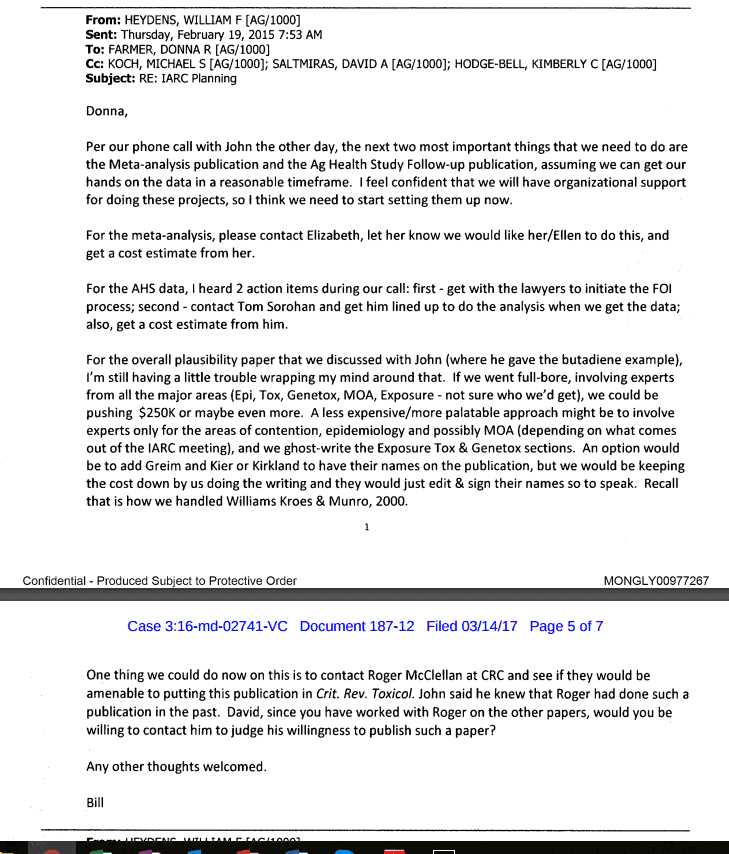
In 2015, William Heydens, a Monsanto scientist, suggested that he and colleagues “ghost-write” another scientific paper. Monsanto could pay outside scientists to “edit & sign their names” to the work that he and others would do, Heydens wrote in an email. “Recall that is how we handled Williams Kroes and Munro 2000.”
The emails were spotlighted in jury trials in which plaintiffs suffering from cancer won billions of dollars in damages from Monsanto, which was bought by Bayer AG in 2018.
Gary Williams, one of the authors of the now retracted 2000 research paper, could not immediately be reached for comment. In 2017, Williams’s former employer New York Medical School said it found “no evidence” that a faculty member violated the school’s prohibition against authoring a paper ghostwritten by employees of Monsanto. The two other authors of the paper, Robert Kroes and Ian Munro, are deceased.
In explaining the decision to retract the 25-year-old research paper, Van den Berg wrote: “Concerns were raised regarding the authorship of this paper, validity of the research findings in the context of misrepresentation of the contributions by the authors and the study sponsor and potential conflicts of interest of the authors.”
He noted that the paper’s conclusions regarding the carcinogenicity of glyphosate were solely based on unpublished studies from Monsanto, ignoring other outside, published research.
Van den Berg did not respond to a request for comment.
When asked about the retraction, Bayer said in a statement that Monsanto’s involvement was adequately noted in the acknowledgments section of the paper in question, including a statement that referred to “key personnel at Monsanto who provided scientific support”. The company said the vast majority of thousands of published studies on glyphosate had no Monsanto involvement.
“The consensus among regulatory bodies worldwide that have conducted their own independent assessments based on the weight of evidence is that glyphosate can be used safely as directed and is not carcinogenic,” the company said.
An EPA spokesperson said that the agency was aware of the retraction but “has never relied on this specific article in developing any of its regulatory conclusions on glyphosate”.
The spokesperson said the EPA has “extensively studied glyphosate, reviewing more than 6,000 studies across all disciplines, including human and environmental health, in developing its regulatory conclusions”.
The updated human health risk assessment the agency is currently conducting for glyphosate is “using gold standard science”, the spokesman said. That assessment should be released for public comment in 2026 and will not rely on the retracted article.
“The retraction of this study is a long time coming,” said Brent Wisner, one of the lead lawyers in the Roundup litigation and a key player in getting the internal documents revealed to the public.
Wisner said the Williams, Kroes and Munro study was the “quintessential example of how companies like Monsanto could fundamentally undermine the peer-review process through ghostwriting, cherrypicking unpublished studies, and biased interpretations”.
“This garbage ghostwritten study finally got the fate it deserved,” Wisner said. “Hopefully, journals will now be more vigilant in protecting the impartiality of science on which so many people depend.”
News of the retraction of the study came in the same week the Trump administration urged the US supreme court to take up Bayer’s bid to curtail thousands of lawsuits claiming Roundup causes cancer.
In a brief filed at the court, the solicitor general, D John Sauer, said the company was correct that the federal law governing pesticides pre-empts lawsuits that make failure-to-warn claims over the products under state law.
Plaintiffs have said they developed non-Hodgkin’s lymphoma and other forms of cancer due to using Roundup and other glyphosate-based herbicides sold by the company, either at home or on the job.
More at:


More Stories
Senator Chris Murphy Thinks Government Regulation of the Internet Would Prevent the Public From Electing Another Donald Trump (VIDEO)
Late Friday Trump Bombshell: US Makes Deal For ‘Permanent Control’ Over Greenland’s Security
‘Big Short’ Maven Michael Burry Argues AI Companies Are Hyping Panic To Cover For Slowing Growth In The Industry